
Threads
The Cloth From the Coast
In Bahia, Brazil, the pano da costa is a shawl of West African strip cloth. It crossed the Atlantic with the people who wore it, and it never stopped meaning something.
The coast, on her shoulder. Image: The Uju Edit, created with AI.

01 / 10
It means "cloth from the coast."
In nineteenth-century Brazil, "da Costa" was the label for goods from the African coast: soap, cowrie shells, cloth. Over time, the name settled on one thing, a shawl.
Cloth from the coast. Image: The Uju Edit, created with AI.

02 / 10
It's strip cloth.
Weavers make it on narrow looms in long bands, then sew the bands edge to edge into a shawl about two meters long. In Yoruba, the cloth is called alaká.
Narrow bands, sewn edge to edge. Image: The Uju Edit, created with AI.

03 / 10
It crossed with the people.
One account, recorded at a Salvador terreiro: the first panos arrived on the bodies of enslaved African women. The slave trade to Bahia peaked from 1801 to 1825.
Sold as bands, sewn at home. Image: The Uju Edit, created with AI.

04 / 10
Then it became a trade.
Black sailors, freed Africans and Afro-Brazilian vendors kept the cloth moving between the Bight of Benin and Salvador. By 1857, Lagos was exporting about 50,000 a year.
The weaving side of the route. Image: The Uju Edit, created with AI.
05 / 10
"We baianas are a living heritage."Rita Santos, president of the National Association of Baianas de Acarajé (translated from Portuguese)

06 / 10
Bahia turned up the color.
The older African cloths were mostly indigo blue and white. The bright panos were a Bahian development, and in Candomblé, a pano's color can point to an orixá.
Bahia's colors. Image: The Uju Edit, created with AI.

07 / 10
How you tie it says something.
Over one shoulder for going out. Crossed at the chest or wrapped at the waist for religious occasions. In some Candomblé houses, where it sits marks your rank.
One cloth, three ways to wear it. Image: The Uju Edit, created with AI.

08 / 10
When the ships stopped, Bahia wove.
By the early 1900s, only three or four ships a year sailed from Salvador to Africa. Local weavers kept the cloth going, and in 1984 a master weaver led the first course in it.
Bahia wove its own. Image: The Uju Edit, created with AI.

09 / 10
It's still on the street.
The baianas de acarajé sell street food in the full outfit: wide skirt, blouse, head tie, beads and the pano. Their trade is part of Brazil's national heritage.
Still on the street. Image: The Uju Edit, created with AI.

10 / 10
Know the pieces.
The bata is the embroidered blouse and the torço is the head tie. Fios de contas are bead necklaces, and balangandãs are clusters of silver charms.
Torço, bata, contas, balangandãs. Image: The Uju Edit, created with AI.
The Essentials, complete
You have the essentials.
Want the Lagos connection, the master weaver and the Carmen Miranda detour? The Full Story takes about 8 minutes.
Keep reading: The Full StoryThe Full Story · 8 min
The Cloth From the Coast
In 1896, a woman named Felicidade Maria de Sant'Anna imported 24 panos da costa from Lagos into Bahia. They were worth 216 mil-réis.
That's nearly all the record says about her. The historian Mary E. Hicks cites the shipment in her study of the West African cloth trade to Salvador. But it tells you a lot about the cloth. Sixty-one years after the Malê revolt and eight years after Brazil abolished slavery, someone in Bahia was still ordering shawls from the other side of the Atlantic.
You can still see that cloth in Salvador today. It's on the shoulders of the baianas de acarajé who sell fritters on street corners, in the processions of the Recôncavo, in Candomblé houses and in samba school parades. And its name tells you exactly where it came from.
Cloth from the coast
Pano da costa means "cloth from the coast," and the coast is Africa's. In nineteenth-century Brazil, imports from West Africa carried the same label: sabão da Costa (soap), búzio da Costa (cowrie shells), pano da Costa (cloth). The anthropologist Heloísa Alberto Torres, who studied the dress of Afro-Bahian women in a 1950 thesis, noted that the phrase first covered all imported African cloth before it narrowed to one garment, the shawl.
The shawl itself is strip cloth. Weavers work on narrow looms, producing long bands about a hand's width across, then sew the bands together edge to edge until the piece is roughly two meters long and a meter wide. If that sounds familiar, it should. It's the same method behind kente and behind aso oke, the Yoruba cloth from our aso-ebi story. In Yoruba, the cloth is called alaká.
Torres also described how it was sold. The cloth often arrived from Africa as woven bands, rolled up and kept in a calabash, and the buyer sewed them into a shawl.
Narrow bands, sewn edge to edge. Image: The Uju Edit, created with AI.
It came with the people
The pano da costa is a West African garment that became Brazilian under the worst conditions imaginable. The slave trade to Bahia peaked between 1801 and 1825, when an estimated 258,736 Africans were landed in Salvador, many of them from the Bight of Benin. Researchers working with weavers at Salvador's Casa Branca terreiro recorded how the story is told there: the first panos came on the bodies of enslaved women, who were sold wrapped in them.
The cloth kept coming. Hicks has shown how a cloth trade grew up inside the slave trade itself. Enslaved and freed African sailors on Bahian ships were allowed to carry small amounts of goods as compensation for their labor, and a network of African and Afro-Brazilian shopkeepers and street vendors sold the panos in Salvador. Some of the people sending cloth were Afro-Brazilian women. The two trades were tangled together: in 1812, one trader in Ouidah bought 48 panos along with 95 captives.
People wore the cloth as soon as they could get it. Runaway notices in Bahian newspapers between 1815 and 1847 describe enslaved people dressed in panos, including a girl of 11 or 12 and a Nagô woman whose pano was described as English, likely an imitation from a British mill. (If you read our wax print story, you know Europe has been copying West African cloth for a long time.) In 1835, the German artist Johann Moritz Rugendas drew Bahian women wearing panos as shoulder shawls and head wraps.
The cloth trade grew up inside the slave trade, and it outlived it.
The trip back
Then the route started running both ways. In January 1835, enslaved and freed Muslim Africans in Salvador led the Malê revolt. In the repression that followed, many freed Africans left Brazil for the Bight of Benin. The historian Lisa Earl Castillo identifies 1835 to 1837 as the first and biggest wave of these returns. More followed over the century, and the returnees came to be known in West Africa as Agudás.
The Brazilian historian and diplomat Alberto da Costa e Silva described Brazilian quarters in Accra, Agoué, Ouidah, Porto Novo, Badagry and Lagos. Cloth was part of the traffic between the two shores. By 1857, Lagos was exporting about 50,000 panos a year. Ships also carried palm oil and other West African goods that Candomblé relied on. But the traffic dried up. In 1867, 23 ships sailed from Salvador to Africa. By the early 1900s, it was three or four a year.
The weaving side of the route. Image: The Uju Edit, created with AI.
Bahia made it its own
Somewhere along the way, the pano da costa changed. Torres found that the older African pieces were mostly indigo blue and white. The bright, multicolored panos, she argued, were a Bahian development, shaped by Catholic church vestments, Candomblé and carnival. In Candomblé, each orixá has its colors, and the color of a woman's pano can show which one she's dedicated to.
So can the way she ties it. The anthropologist Raul Lody lists several ways: over one shoulder and down the back for going out, crossed over the chest or wrapped at the waist for religious occasions, draped as a veil for protection. On a workday, the same cloth becomes a pano de trabalho, a work cloth. Inside Candomblé houses, placement can signal rank. In one account, the head priestess wears hers on the left shoulder, while novices wrap theirs at chest height.
Cachoeira, a river town in the Recôncavo, is home to the Irmandade da Boa Morte (Sisterhood of the Good Death), a brotherhood of Black women that dates to the early nineteenth century. Every August, its members process through the streets in white, with panos on their backs. Their pano is red on one side and black on the other: the red side for joy, the black side for mourning. The festival has been part of Bahia's official intangible heritage since 2010.
Bahia's colors. Image: The Uju Edit, created with AI.
One cloth, three ways to wear it. Image: The Uju Edit, created with AI.
When the ships stopped
As the ships thinned out, Bahia wove its own. Torres recorded a family in Salvador, the Conceição family, weaving panos on African-style looms, sometimes working in bands imported from Africa. In 1940, the American anthropologist Melville Herskovits found locally hand-loomed cloth for sale in Salvador, though the African kind was "worth much more."
Keeping the craft alive took deliberate work. Its best-known twentieth-century keeper was Abdias do Nascimento Nobre, a weaver of African descent born in 1910 in Santo Antônio Além do Carmo, in Salvador's historic center. In 1984, IPAC, Bahia's state heritage institute, launched a project around his weaving, and the first course dedicated to the pano da costa opened that year at the Ilê Axé Opô Afonjá terreiro. Mestre Abdias taught it with his daughter, the artisan Maria de Lourdes Nobre. He died in 1994.
Weavers are still at it in the same terreiro. At the Casa do Alaká, a shop inside the Opô Afonjá, three weavers, Iraildes Santos, Norma Alves and Ana Eugênia, were making about 23 panos da costa a month between them in 2023, the Salvador newspaper A Tarde reported. Their steadiest customers are visitors to the terreiro. Santos told the paper that her registered artisan's card lets her say she has a profession.
Bahia wove its own. Image: The Uju Edit, created with AI.
On the street
The place most people see a pano da costa today is a street corner. The baianas de acarajé sell acarajé (black-eyed pea fritters fried in dendê palm oil) and other Afro-Bahian foods from wooden trays, and they work in the full outfit: a wide skirt, an embroidered blouse, a head tie, bead necklaces and the pano. Their trade was registered as part of Brazil's national intangible heritage in 2005. Their association says the trade supports more than 10,000 workers.
Salvador takes the outfit seriously. A 2015 city decree requires baianas to sell in traditional dress, including the head tie and necklaces. Rita Santos, who leads the national baianas' association, stood beside the mayor when he presented it. "Few baianas actually dress the part these days," she told the local site Bahia Notícias, explaining why the rules had to be firm.
Every November 25 is National Baiana de Acarajé Day, a date made official nationwide in 2010. In Salvador, it traditionally opens with a mass at the Church of Our Lady of the Rosary of the Black People, in the Pelourinho.
Still on the street. Image: The Uju Edit, created with AI.
The costume and the cloth
The baiana's outfit also became one of Brazil's most exported images, and not always on Black women. In 1939, the Portuguese-born singer Carmen Miranda performed Dorival Caymmi's "O que é que a baiana tem?" ("What Does the Baiana Have?") in the film Banana da Terra, wearing a glamorized version of the baiana's dress. The look became her trademark, and the baiana became a costume the whole world recognized.
The real thing never went away. Rio's samba schools parade an ala das baianas, a wing of women in wide spinning skirts, as a required part of the parade. The Salvador brand Meninos Rei designed the prints for the baianas of Mangueira, one of Rio's most famous schools. And on Salvador's streets, the baianas themselves insist on the difference: as Santos has put it, a baiana is more than someone selling a fried snack.
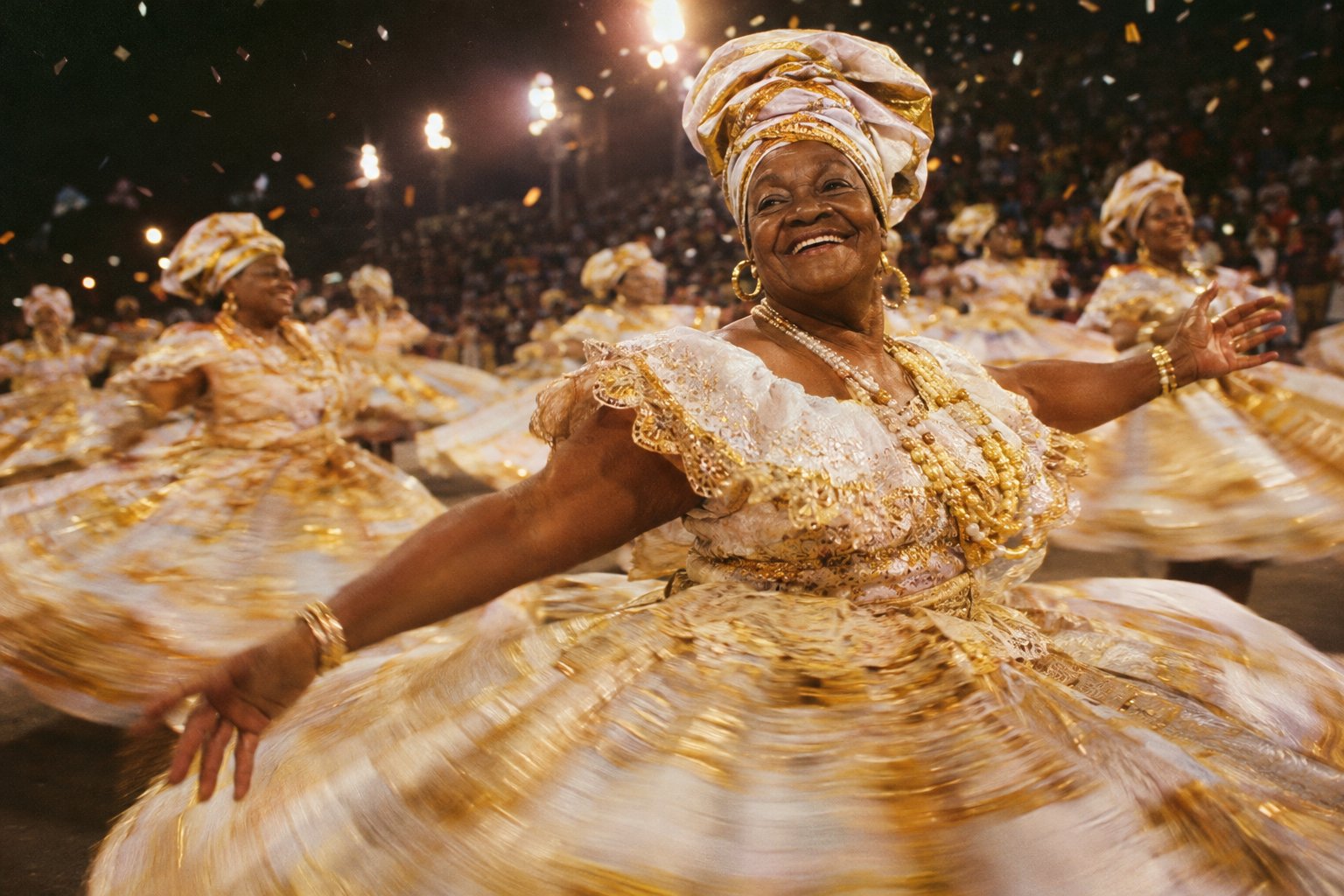
The baianas' wing. Image: The Uju Edit, created with AI.
Both directions
In Iseyin, in southwestern Nigeria, demand for aso oke is rising sharply, Africanews reported in April, driven partly by the diaspora and the global reach of Nigerian fashion and music. Designers are putting it on runways in London and Paris.
The pano da costa shows how long that pull has been working. A narrow strip of West African weaving crossed the Atlantic with people who had lost nearly everything, and it kept its meaning. Bahia added color, rules and its own weavers. Lagos kept sending more. Two centuries later, a baiana on a Salvador street corner is still wearing the coast on her shoulder.
A baiana on a Salvador street corner is still wearing the coast on her shoulder.
The coast, on her shoulder. Image: The Uju Edit, created with AI.
Designer to know
Meninos Rei
Salvador, Brazil
Brothers Júnior and Céu Rocha started Meninos Rei in Itapuã, Salvador, more than a decade ago. They build tailoring, jumpsuits and patchwork from African fabrics, with prints that reference Afro-Brazilian ancestry and Candomblé. The brand has shown at São Paulo Fashion Week, in Milan and, in October 2026, at the Macau Fashion Festival in China. They also designed the prints for Mangueira's ala das baianas.
Meet the designerSources and research
- Transatlantic Threads of Meaning: West African Textile Entrepreneurship in Salvador da Bahia, 1770-1870 · Mary E. Hicks, Slavery & Abolition 41:4, December 2020
- Alguns aspectos da indumentária da crioula baiana · Heloísa Alberto Torres (1950 thesis), republished in Cadernos Pagu 23, 2004
- O pano da costa e o torço como panos de vestir · Ketilley Luciane de Jesus Purpura and Francisca Dantas Mendes, Revista Calundu, 2023
- Pano da Costa: Fazeres Artesanais na Casa da Vovó Conceição · Elda Cilene Fonseca Costa Santos, Tanesca Santana Santos and Walter de Oliveira Pinto Júnior, RIGS
- Sartorial Practices (on Rugendas and panos da costa) · Afterlives, University of Chicago
- Em busca dos Agudás da Bahia: trajetórias individuais e mudanças demográficas no século XIX · Lisa Louise Earl Castillo, Afro-Ásia 55
- O Brasil, a África e o Atlântico no século XIX · Alberto da Costa e Silva, Estudos Avançados (USP), 1994
- Candomblé and Atlantic trade: palm oil, shellfish and the pano da costa · Revista da ABPHE
- Livro "Pano da Costa" resgata história do principal produto africano exportado e consumido na Bahia · Jornal Grande Bahia
- Artesanato baiano já cresceu 20% somente este ano · Mariana Bamberg, A Tarde, September 2023
- Pano da Costa · Cadernos do IPAC 1, Fundação Pedro Calmon, 2009 (book)
- Patrimônio Imaterial: Ofício das Baianas de Acarajé · IPHAN Bahia
- Ipac revalida registro especial do ofício das baianas de acarajé · Government of Bahia, November 2024
- Com novo decreto, baianas do acarajé serão obrigadas a usar trajes típicos · Bahia Notícias, December 2015
- Entrevista: Rita Santos · Bahia Notícias, December 2015
- Decreto nº 26.804, de 1º de dezembro de 2015 · Diário Oficial do Salvador
- Objetivo é preservar o ofício da baiana, argumenta Rosemma Maluf · BNews, December 2015
- Baianas de acarajé simbolizam a cultura e a resistência das mulheres negras · A Tarde Memória
- Dia da Baiana de Acarajé é festejado com apoio da SECULT Bahia · Jornal Grande Bahia, November 2017
- Campanha "Dia da Baiana Feliz" fortalece a tradição do acarajé · BNews, October 2023
- Baianas de acarajé: vestir a ancestralidade · Estado de Minas
- Irmandade da Boa Morte é celebrada nesta terça em Cachoeira · A Tarde
- Autoridades da Cultura participam da Festa da Irmandade de Nossa Senhora da Boa Morte · Bahia Secretariat of Culture, August 2025
- Festa de Nossa Senhora da Boa Morte celebra luta pela liberdade · Brasil de Fato, August 2019
- "O que é que a baiana tem?" and the baiana's dress · ModaPalavra e-periódico
- Brasil vai comemorar Dia da Baiana de Acarajé · Congresso em Foco
- Estampas da Ala das Baianas da Mangueira são assinadas pela Meninos Rei · Bahia Notícias
- Meninos Rei leva moda baiana à passarela do Macau Fashion Festival 2026 · Bahia Notícias, October 2026
- Meninos Rei representa o Brasil no Macau Fashion Festival 2026 · Correio, October 2026
- Meet 09 brands from Bahian creators · Visit Salvador da Bahia
- Nigeria's aso-oke weaving tradition gains global spotlight · Africanews, April 2026
Is there a cloth in your family that crossed an ocean? What did it mean to the person who carried it?


In conversation
0 comments
Sign in by email to comment
First comments and comments with links await review. Community guidelines