
Threads
So, is Ankara African?
The technique is Javanese. The first factories were European. The meaning was made in West Africa. All three are true.
A sculpted sleeve, a matching headwrap, an original wax print. Image: The Uju Edit, created with AI.

01 / 10
It started in Java.
Batik is Indonesian. Makers drew hot wax onto cotton by hand, dyed it, then waxed and dyed again. One sarong could take months.
Wax drawn by hand onto cotton in a contemporary batik workshop. Image: The Uju Edit, created with AI.

02 / 10
Europe tried to copy it.
In the 1850s, Dutch factories in Haarlem and Helmond built machines to fake batik's look. Java wasn't impressed. The resin cracked, the dye bled, and buyers saw spoiled cloth.
Cotton weave, resin crackle and small pale marks in an original wax print. Image: The Uju Edit, created with AI.

03 / 10
West Africa saw something else.
In 1893, a Scottish trader named Ebenezer Brown Fleming brought the Dutch prints to the Gold Coast. Buyers loved the crackle. Factories started designing for them.
The cloth market: patterns folded, stacked and chosen. Image: The Uju Edit, created with AI.
04 / 10
The factory gave each pattern a number. The market gave it a name.

05 / 10
Women gave it a language.
Two birds leaving a cage became Si tu sors, je sors: you leave, I leave. Another pattern became Michelle Obama's handbag. The names came from the market, often from the women who sold and wore the cloth.
A conversation over cloth at a market stall. Image: The Uju Edit, created with AI.

06 / 10
The Nana Benz ran the trade.
From the 1960s to the early '80s, a small circle of Togolese women controlled wax print from Lomé's Grand Marché. Their Mercedes-Benz cars gave them the name.
A contemporary AI tribute to the Nana Benz; this is not a portrait of a real trader. Image: The Uju Edit, created with AI.

07 / 10
Then Africa built its own mills.
Ghana Textile Printing opened in Tema in 1966. Akosombo Textiles followed in 1967. In September 2026, a Ghanaian firm agreed to buy GTP from Vlisco.
A contemporary textile-mill scene illustrating factory production. Image: The Uju Edit, created with AI.

08 / 10
So, is it African?
The technique is Javanese. The first factories were European. The meaning was made in West Africa. All three are true.
Wax print in motion on a contemporary city street. Image: The Uju Edit, created with AI.
09 / 10
A factory address can tell you where a cloth was printed. It can't tell you what the cloth means.

10 / 10
Know your cloth.
Wax print is one cloth among many. Kente is woven. Adire is dyed by hand with indigo. Bogolan is painted with mud.
Kente, adire, bogolan and wax print: four distinct textile traditions, illustrated with AI. Image: The Uju Edit, created with AI.
The Essentials, complete
You have the essentials.
Want the soldiers' legend, the Scottish trader and the women who named everything? The Full Story takes about 8 minutes.
Keep reading: The Full StoryThe Full Story · 8 min
So, is Ankara African?
It goes around every few months. A WhatsApp broadcast, a TikTok, a thread full of shocked faces: Ankara isn't African. It's Dutch. Or Indonesian. Or, these days, Chinese.
None of that is exactly wrong. It's just the first page of a far better story, one that runs from the batik workshops of Java to the factories of Haarlem to a market in Lomé, where a few women decided which patterns traders from Lagos to Kinshasa would carry home.
Here's the whole thing.
It started in Java
Batik is an Indonesian art. On Java, makers draw lines of hot wax onto cotton with a canting, a small copper pen with a bowl for the wax. Wherever the wax sits, dye can't reach. Then the cloth is waxed again and dyed again, color by color. A single sarong could take weeks, sometimes months.
The Dutch had traded batik since the 1600s. The idea of copying it by machine took hold after 1811, when Britain briefly seized Java. Its governor, Thomas Stamford Raffles, documented hand batik and sent 22 pieces back to England with a challenge: mechanize this. Java went back to the Netherlands a few years later, and the Dutch won the race.
The copy Java didn't want
In 1846, Pieter Fentener van Vlissingen bought a textile printing works in Helmond, a small Dutch town. It became P.F. van Vlissingen & Co., known today as Vlisco. In Haarlem, a rival works patented its own batik printing machine in 1854 and kept the method secret for decades. The goal was cheap batik for Java's enormous market.
Java mostly said no. The machines couldn't lift all the resin, so dye seeped into fine cracks and left spots where it didn't belong. To Javanese buyers, that looked like spoiled cloth. Local makers also sped up their own work with copper stamps called cap, which cut their costs. The cheap copy had lost its one selling point.
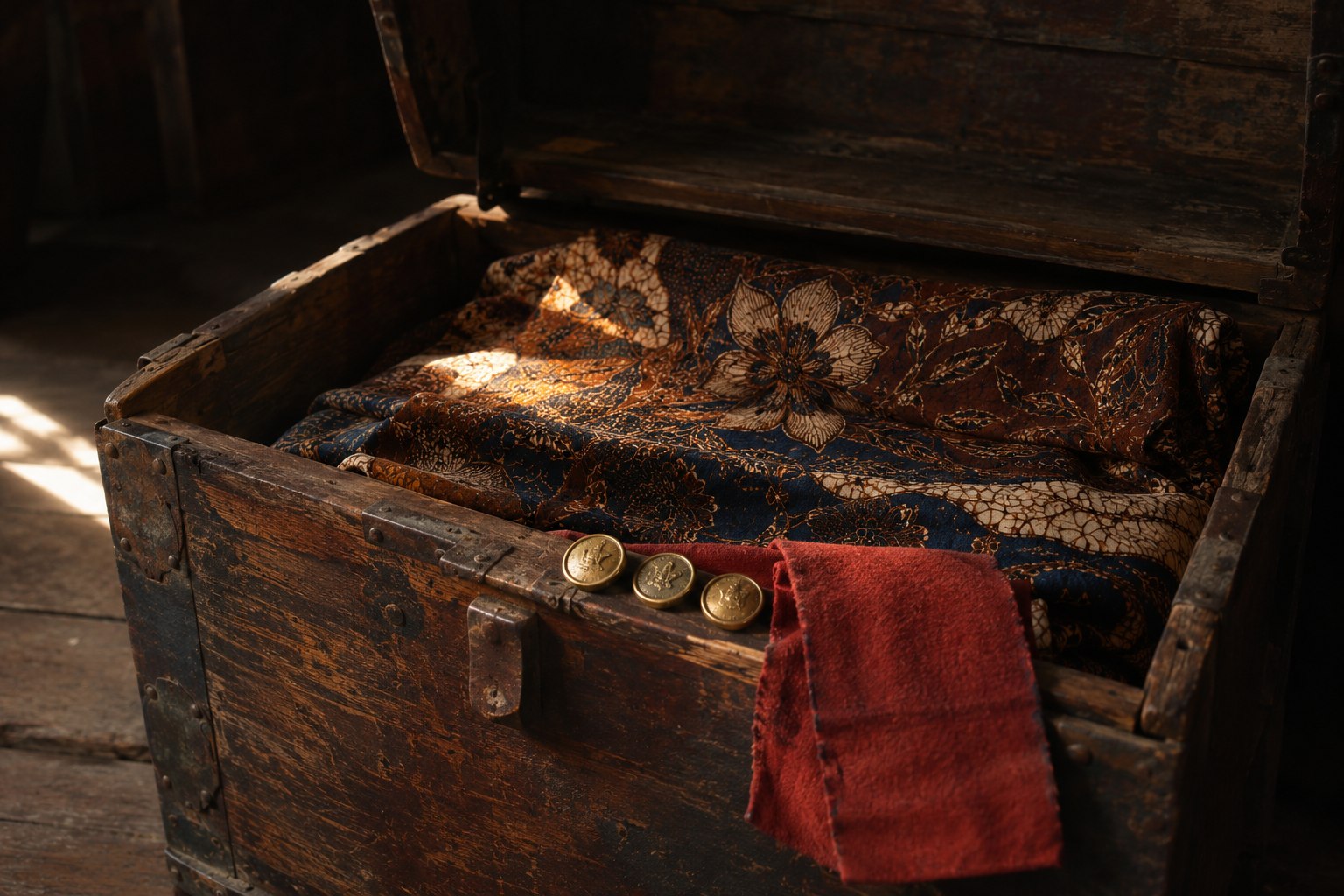
A contemporary AI still life illustrating the soldiers’ legend discussed as a myth; this is not an archival photograph. Image: The Uju Edit, created with AI.
The legend of the Black Dutchmen
Here's where the story usually takes a romantic turn.
Between 1831 and 1872, about 3,000 West African men, most of them Akan, sailed from Elmina on the Gold Coast to serve in the Dutch colonial army in the East Indies. On Java they were called Belanda Hitam: Black Dutchmen. When their contracts ended, some stayed and raised Indo-African families. Others came home, and many settled on a hill behind Elmina's castle that people still call Java Hill.
The legend says these veterans brought batik home in their trunks and started West Africa's love affair with it. Vlisco and the British maker ABC have both told versions of it. The historian Ineke van Kessel calls it a myth. The returning soldiers, she points out, were poor men who couldn't have afforded the cloth.
The legend still points at something true. Before wax print ever reached the Gold Coast, the Dutch empire had already tied it to Java through its army.
The trader who listened
The documented route is less romantic and more commercial. In 1893, a Scottish merchant named Ebenezer Brown Fleming brought Dutch-made imitation batik, printed in Haarlem by the firm of Prévinaire, to the Gold Coast.
His customers didn't compare it to Javanese batik. They judged it on its own terms and liked what they saw, including the crackle Java had rejected. Fleming paid attention. He adapted the designs to his buyers' taste and added motifs they asked for. That group of designs, now called the Haarlem Collection, produced classics that are still in print. By 1907 he was commissioning English printers too.
The flaw became the signature. Makers now put the veins and bubbles in on purpose. In the early 1930s, Vlisco's executives traveled to West Africa to study their customers, and from 1934 the company's designs took on a distinctly West African style.
The cloth picked up local names, too. Nigeria calls it Ankara. The most repeated explanation says the word came from Accra, where Hausa traders bought the cloth, though nobody has proven it. Francophone West Africa says pagne or wax hollandais. East Africa says kitenge.
Cotton weave, resin crackle and small pale marks in an original wax print. Image: The Uju Edit, created with AI.
The cloth market: patterns folded, stacked and chosen. Image: The Uju Edit, created with AI.
The market named everything
Each pattern left the factory with a number. The market gave it a name.
Two birds fly from an open cage, and the pattern becomes Si tu sors, je sors: you leave, I leave. Vlisco's own catalog reads it as a warning to an unfaithful partner: if you stray, so will I. Others wear it as a young woman's claim to respect.
A pattern known in Nigeria as Jumping Horse became a favorite aso-ebi for Igbo women, the matching cloth that shows family and community ties. In Côte d'Ivoire, the same cloth is called I Run Faster Than My Rival, a line about co-wives.
One motif, the wings of Garuda, the bird that carries the Hindu god Vishnu, traveled from Hindu myth through Javanese batik and a Dutch design studio before West African sellers renamed it the snail out of its shell. Translation: mind your own business.
The names keep coming. Barack Obama's election brought Michelle Obama's handbag. A cluster of three trees, released as Kofi Annan was finishing his last term at the UN, became Kofi Annan's brains. There's Nkrumah's pencils, for the intellect of Ghana's first president. And a single design can carry different names across borders. One Dutch print first made in 1911 answers to Leidse Ruit, Linoleum, Round Table and Broken Pots.
Choosing a pattern was never a small decision. It was a message worn in public.
Even Vlisco says it plainly: its prints may be made in the Netherlands, but their names and meanings are often decided by the African women who sell and wear them.
A complete outfit takes about six yards. So choosing a pattern was never a small decision. It was a message worn in public, to a rival, a husband or a whole room, saying what you couldn't say out loud.
A conversation over cloth at a market stall. Image: The Uju Edit, created with AI.
The Nana Benz
Nowhere did women hold more power over the cloth than in Lomé.
After independence, Ghana's high tariffs made imported wax print unprofitable, while neighboring Togo kept its tariffs low. In the late 1950s, the trade moved from Accra to Lomé's Grand Marché, also known as Assigamé. There, a group of about 15 women became super-wholesalers. Manufacturers supplied certain patterns only to certain women, and a successful trader could be the sole wholesaler for more than 60 designs. Buyers came from Accra and Kumasi, Cotonou and Lagos, Onitsha, Kinshasa and Libreville.
People called them the Nana Benz: Nana for a respected woman, Benz for the Mercedes they drove. In 1965 they formed a professional association that negotiated trade policy directly with the state. By the 1970s, the cloth trade mattered to Togo about as much as phosphate, the country's main export.
They shaped the cloth itself, too. Manufacturers in the Netherlands and England depended on them to know what each market wanted, and the Nanas chose patterns and named the designs they knew would sell.
A contemporary AI tribute to the Nana Benz; this is not a portrait of a real trader. Image: The Uju Edit, created with AI.
Their era ended in stages. In 1994, the CFA franc lost half its value, which roughly doubled the price of wax cloth. Liberalization then ended the exclusive distribution system that had made the trade so profitable, and in the early 2000s Chinese copies arrived. The youngest and last of the original Nana Benz, Dédé Rose Gamélé Creppy, known as Maman Creppy, died at 89. Her daughter, Yvette Sivomey, now works with Vlisco to bring old patterns back in new colors.
Made in Africa, too
Independence brought new mills. Ghana Textile Printing, known as GTP, launched in Tema in January 1966 under Kwame Nkrumah. Akosombo Textiles followed in 1967. Nigeria built a large textile industry of its own after 1960. In 2004, Ghana began encouraging people to wear national dress to work on Fridays, a campaign meant to support local textiles.
Cheap imports have hit those mills hard. Akosombo's factory could print 28 million yards a year. In 2018, it printed one million. When University of Manchester researchers checked Lomé's market in 2025, six yards of Chinese-made print sold for about 9,000 CFA francs, around $16. Six yards of Dutch wax cost about 50,000, around $87.
Ownership is shifting too. In September 2026, the Ghanaian investment firm Olive Africa Partners Fashions agreed to buy TexStyles Ghana, the company behind GTP and Woodin, from Vlisco. The deal made two of West Africa's best-known print brands fully Ghanaian-owned.
A contemporary textile-mill scene illustrating factory production. Image: The Uju Edit, created with AI.
Not everyone wants it
Some African designers won't use wax print at all. The Ghanaian designer Nana Kwame Adusei told the BBC that wax print companies have been making money for 170 years, and "the money doesn't come back to us." The Nigerian designer Amaka Osakwe of Maki Oh has been put off using it too. The Malian-born indigo dyer Aboubakar Fofana has said he can't accept wax print as a symbol of African-ness.
Their worry is fair. When one factory cloth stands in for a whole continent, it crowds out the textiles Africans have made by hand for generations: kente, woven in narrow strips by Asante and Ewe weavers; adire, the Yoruba indigo cloth patterned with resist; bogolan, Mali's mud cloth. Each deserves its own story, and each will get one here.
Kente, adire, bogolan and wax print: four distinct textile traditions, illustrated with AI. Image: The Uju Edit, created with AI.
So, is Ankara African?
Yes. And not only.
Its technique is Javanese. Its factories were Dutch and British, and today much of it is made in China. But its names, its meanings, its markets and its moments were made in West Africa, largely by women: the family aso-ebi at a wedding, the Friday office, the six yards that said what you couldn't say out loud.
A factory address can tell you where a cloth was printed. It can't tell you what the cloth means.
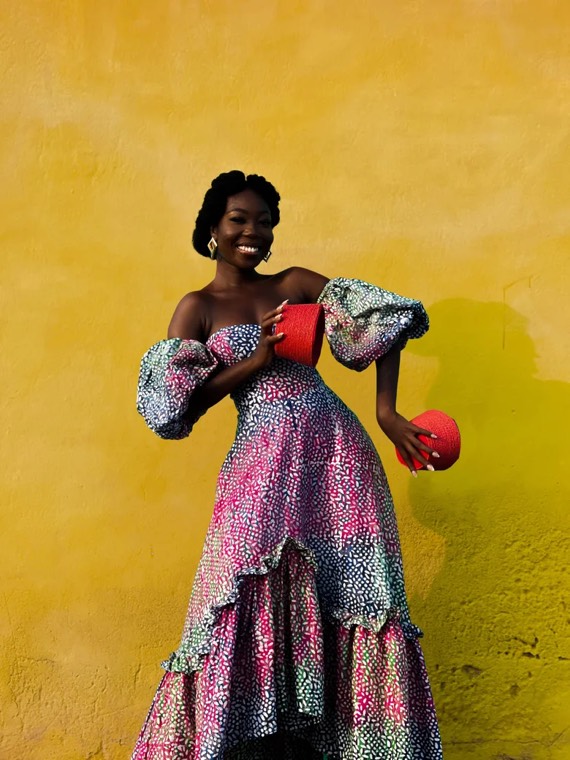
Wax print in motion on a contemporary city street. Image: The Uju Edit, created with AI.
Sources and research
- Ankara textile by Brown Fleming Ltd · Victoria and Albert Museum
- Ankara textile with deliberate crackle · Victoria and Albert Museum
- Leidse Ruit dress fabric · Victoria and Albert Museum
- Fabric of the African Diaspora · Victoria and Albert Museum
- The founding of Vlisco · Vlisco
- One white fabric, many meanings · Vlisco
- Vlisco and West African printed textiles · Textile Research Centre, Leiden
- The Fabled Cloth and its IP Future · World Intellectual Property Organization
- The Modern Tale of Nigerian Wax-Resist Textiles · WIPO Magazine, 2009
- Wax print: Africa's pride or colonial legacy? · BBC
- The Black Dutchmen: African soldiers in the Netherlands East Indies · Ineke van Kessel, Leiden University
- Wax prints in West Africa: unravelling the myth of Dutch colonial soldiers as cultural brokers · Ineke van Kessel, African Studies Centre Leiden
- Brown Fleming and the Haarlem Collection · Helen Elands (ed.), Silvana Editoriale, 2025 (book)
- African history told through fashionable printed clothing · Africa Renewal, United Nations
- Girl Boss · Anne Grosfilley, Selvedge
- Textile queen Maman Creppy has died · Nina Sylvanus, The Conversation
- Togo's Nana-Benz: how cheap Chinese imports hurt the famous traders · University of Manchester
- Our story · GTP
- African wax print fabric design and production history of Akosombo Textiles Limited · Journal of African Arts & Culture, 2023
- The Acculturation of Factory Print · The Nigerian Field, vol. 72
- Fabric wars: Ghana's colourful prints face renewed Chinese competition · MyJoyOnline
- Private equity veteran Kofi Kwakwa's firm acquires GTP and Woodin · MyJoyOnline, September 2026
- Dutch Wax · Asian Textile Studies
- N. Dowuona & Company Advises on Landmark Acquisition of GTP and Woodin · N. Dowuona & Company, September 11, 2026
What makes a cloth feel like yours: where it was made, who gave it meaning, or the way you've lived in it?


In conversation
0 comments
Sign in by email to comment
First comments and comments with links await review. Community guidelines