
Threads
How the Dashiki Got to Harlem (and Back Again)
It began as a Hausa undershirt. A Dutch designer drew its most famous print from Ethiopian robes. Black America made it a statement, then sent it home.
A Harlem stoop, a hand-embroidered dashiki, no explanation needed. Image: The Uju Edit, created with AI.

01 / 10
It started underneath.
The word comes from the Hausa ɗan ciki, "underneath": a short tunic men wore under big robes. The Yoruba called it danshiki and sewed it from hand-woven strip cloth.
Before it was a statement, it was a work shirt cut from strip cloth. Image: The Uju Edit, created with AI.

02 / 10
Its famous print came from Ethiopia, by way of Holland.
In 1962, Vlisco designer Toon van de Manakker drew a print inspired by Ethiopian ceremonial garments. In 1970s Ghana it took the name Angelina, after a hit song.
A designer's border study, the kind of drawing a print begins with. Image: The Uju Edit, created with AI.
03 / 10
A Hausa word. An Ethiopian pattern. A Dutch print. Harlem made it a statement.

04 / 10
Black Is Beautiful came first.
On January 28, 1962, the Naturally '62 show at Harlem's Purple Manor put natural hair and African-inspired clothes on stage. Its slogan spread everywhere.
Natural hair, African-inspired clothes, a Harlem stage. A tribute to the Grandassa Models. Image: The Uju Edit, created with AI.

05 / 10
A Brooklyn couple built a Harlem brand.
In 1967, Mabel Benning started designing dashikis and her husband Jason quit teaching to sell them. Their label, New Breed, ended up in Sears and Bloomingdale's.
Cut panels, a sewing machine and a lamp: how a label starts. Image: The Uju Edit, created with AI.

06 / 10
Wearing it took nerve.
In September 1968, a Boston headmaster suspended two Black students for wearing dashikis. Six thousand students stayed out of school, and the dress code changed.
In 1968, wearing one to school could get you suspended. Image: The Uju Edit, created with AI.

07 / 10
Then Lagos looked at Harlem.
Fela Kuti said Africans had been ashamed to wear their own national dress until they saw photos of Black Americans in dashikis on 125th Street.
Afrobeat-era energy, styled by The Uju Edit. Image: The Uju Edit, created with AI.
08 / 10
"To bridge the gap between native-born Africans and Africans born in America."Kyemah McEntyre, on the dashiki-print prom dress she designed in 2015

09 / 10
It was never a trend.
When ELLE Canada called the dashiki "the new caftan" in 2015, readers pushed back. A shirt worn for generations can't be new.
The dashiki, still in its own lane. Image: The Uju Edit, created with AI.

10 / 10
Know the pieces.
The dashiki is the shirt. Angelina is one print. The agbada is the grand robe on top, sokoto are the trousers, and the kufi is the cap.
Dashiki, agbada, sokoto and kufi. Image: The Uju Edit, created with AI.
The Essentials, complete
You have the essentials.
Want the seamstress in Crown Heights, the Boston walkout and the song that named a print? The Full Story takes about 7 minutes.
Keep reading: The Full StoryThe Full Story · 7 min
How the Dashiki Got to Harlem (and Back Again)
The most famous shirt in Black America started out as an undershirt.
Its name is West African. Its best-known print was drawn by a Dutch designer looking at Ethiopian robes and named after a Ghanaian highlife song. It became a symbol in Harlem. And then Harlem sent it back across the Atlantic, carrying a meaning it didn't have when it left.
Here's how one shirt made the crossing twice.
It started underneath
In Hausa, ɗan ciki means "underneath." It named a short tunic men wore under larger robes. Yoruba speakers borrowed the word as danshiki for a work garment, originally sewn from hand-woven strip cloth, with deep-cut armholes, pockets and four gussets that flared the hem.
The shape is old. Similar tunics have turned up in burial caves in Mali dating to the 12th and 13th centuries. Across West Africa today, men wear versions of it every day with matching trousers. For weddings it's cut from brocade and heavy with embroidery at the neck and cuffs.
Before it was a statement, it was a work shirt cut from strip cloth. Image: The Uju Edit, created with AI.
A print from Ethiopia, by way of Holland
The print most people now picture when they hear "dashiki" has a stranger route.
In 1962, Toon van de Manakker, a designer at the Dutch wax print company Vlisco, created a new design. He worked from photographs of traditional Ethiopian garments, including the embroidered ceremonial robes of Ethiopian Christian noblewomen. Vlisco itself now says the print's close resemblance to those garments has prompted reflection on its history and on how it was designed.
If you read our wax print story, you know what happened next: the factory made it, and the market named it. The design took off in 1970s Ghana around the time The Sweet Talks released a hit song called "Angelina," and the name stuck. In Congo, the same cloth has been called Miriam Makeba and, more recently, Ya Mado, after dancers who wore it in a music video.
A Hausa word, an Ethiopian pattern, a Dutch factory and a Ghanaian song. Black America was about to give it a meaning.
A designer's border study, the kind of drawing a print begins with. Image: The Uju Edit, created with AI.
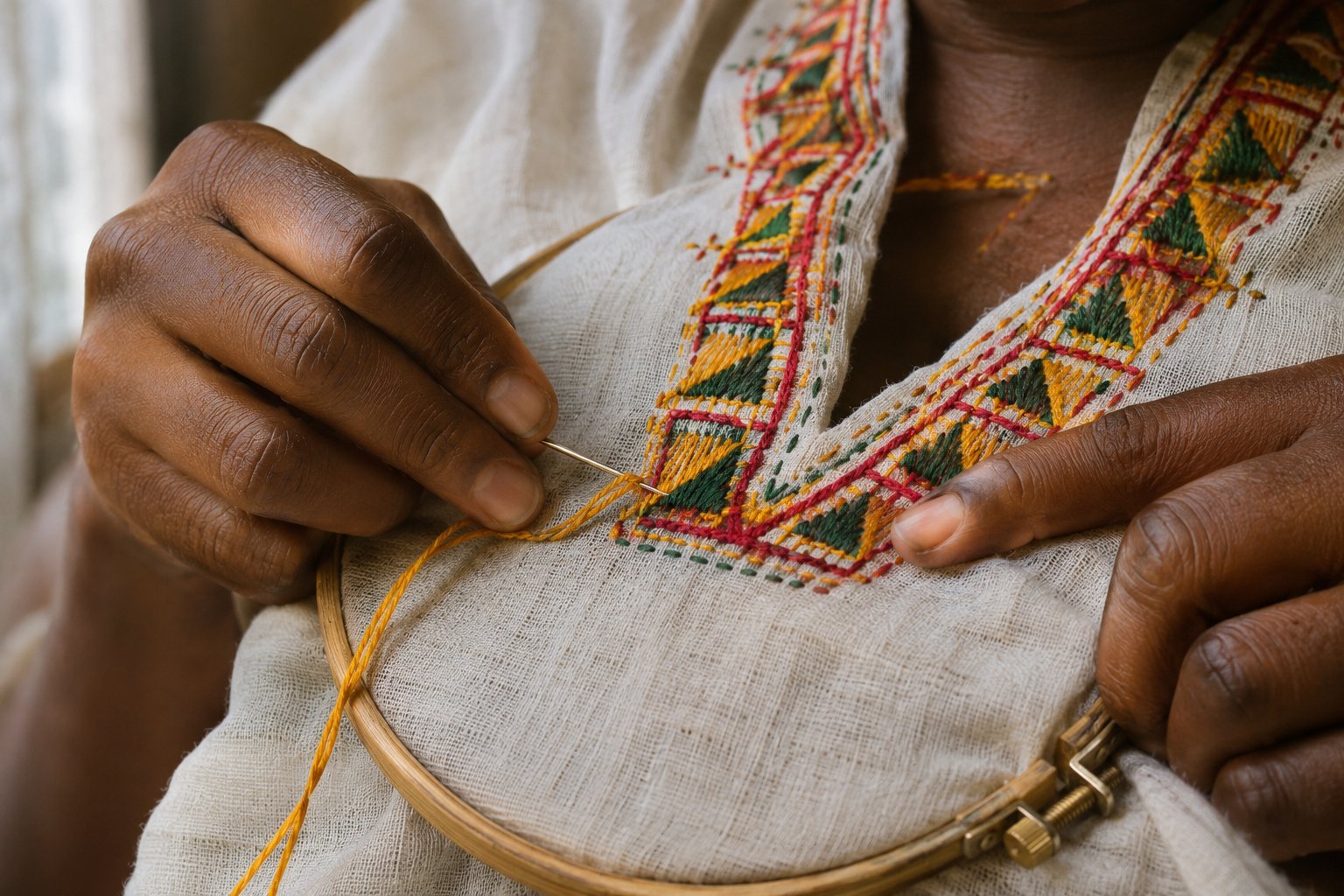
Stitched, or printed to look stitched? Check the neckline. Image: The Uju Edit, created with AI.
Harlem was ready
Before the dashiki, there was a slogan. On January 28, 1962, a crowd packed Harlem's Purple Manor for Naturally '62, a fashion show staged by the photographer Kwame Brathwaite and his brother Elombe Brath through their African Jazz-Art Society & Studios. The jazz artists Abbey Lincoln and Max Roach hosted. The Grandassa Models walked in natural hair and African-inspired clothes, and the posters carried a phrase that would outlive all of them: Black Is Beautiful.
African students and diplomats at the United Nations may have helped inspire the look too. After the Civil Rights Act of 1964, interest in African heritage kept growing. Clothing was one of the most visible ways to show it.
Natural hair, African-inspired clothes, a Harlem stage. A tribute to the Grandassa Models. Image: The Uju Edit, created with AI.
The couple who made it a business
In August 1967, in an apartment on Sullivan Place in Crown Heights, Brooklyn, a seamstress named Mabel Benning began designing dashikis. Her husband, Jason, quit his job teaching Negro history at Queens College to start a company around them: New Breed Clothing.
Their partners included the shoe designer Howard Davis, the clothing designer William Smith and Milton Clarke. A $20,000 loan from the Negro Industrial and Economic Union paid for early prototypes. In January 1968 they bought a brownstone at West 147th Street and St. Nicholas Avenue for their Harlem storefront, and in 1969 they opened a factory in Bedford-Stuyvesant. Boutiques followed in Chicago, Detroit, Los Angeles and Washington, D.C., and New Breed reached mainstream shoppers through Sears and Bloomingdale's. Aretha Franklin, a family friend, wore their designs often.
Davis later said the company wanted to be "to fashion what Motown was to music." It didn't last. By the late 1970s New Breed was in decline, and Davis blamed both inexperience in retail and the fading of the Black Power movement. Its work did last. The Museum of Modern Art acquired a 1968 New Breed dashiki by Jason Benning, Mabel Benning and Howard Davis for its collection.
The word itself arrived in American print at about the same time. Days after the 1967 Newark uprising, the Amsterdam News described a new African garment called a "danshiki." Webster's New World Dictionary later credited J. Benning with the first written use of "dashiki" in 1967.
New Breed wanted to be to fashion what Motown was to music.
Cut panels, a sewing machine and a lamp: how a label starts. Image: The Uju Edit, created with AI.
Clothing as a stand
Worn with an Afro and beads, the dashiki signaled Black Power and Black Is Beautiful. Stokely Carmichael and Huey P. Newton sometimes wore one. So did more moderate civil rights leaders like Jesse Jackson and Andrew Young.
It could also get you thrown out of school. In September 1968, at English High School in Boston, a senior named Glen Grayson and another Black student wore dashikis to class in protest. The headmaster, Dr. Joseph Malone, suspended them, and according to one student, "called them clowns." Black students walked out. On September 27, about 6,000 students stayed home. On October 1, the school system gave in on the dress code.
When Kwanzaa was first celebrated in December 1966, it gave the dashiki another job: holiday wear. It still has it.
Not everyone thought a shirt was enough. Critics warned that dressing African couldn't stand in for political action, and Fred Hampton reportedly made the same point. Henry Louis Gates Jr. later remembered the late-1960s pressure to dress a certain way just to seem "colored enough."
In 1968, wearing one to school could get you suspended. Image: The Uju Edit, created with AI.
Everybody wanted one
By the late 1960s, white counterculture had picked up the dashiki too, and it became a trend in men's fashion. Shops imported cheap versions from South and Southeast Asia, most of them cut from kanga prints, the bordered cotton rectangles of East Africa, shaped by Indian Ocean trade. One kanga-patterned dashiki, with chevrons, geometric shapes and flowers, became a classic still made in the 21st century.
The wider it spread, the less it said. As more white young Americans wore it, the dashiki lost much of its political meaning in the mainstream.
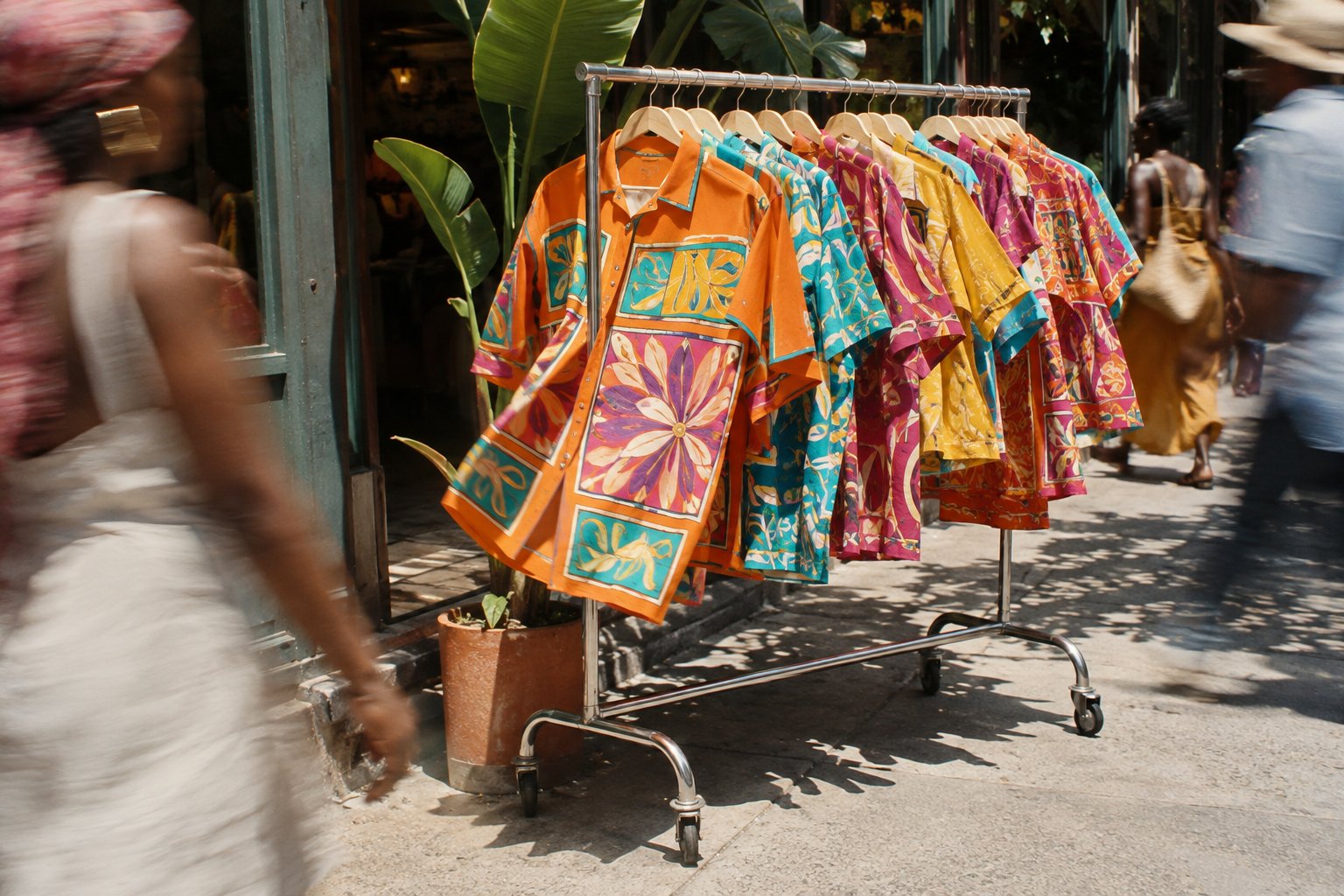
By the late 1960s, dashikis were everywhere, cheap and cheerful. Image: The Uju Edit, created with AI.
Then Lagos looked at Harlem
Here's the turn nobody expects. The dashiki's American moment changed how Africans saw their own clothes.
Fela Kuti, the Nigerian musician who invented Afrobeat, spent time in the United States and came home changed. He later said that Africans had been "ashamed to go around in national dress" until they saw pictures of Black Americans wearing dashikis on 125th Street.
Muhammad Ali wore the dashiki. So did Jimi Hendrix and Miriam Makeba. A Hausa undershirt had crossed the ocean, become a symbol, and come home as a source of pride.
The dashiki crossed the Atlantic twice. It came back saying more than when it left.
Afrobeat-era energy, styled by The Uju Edit. Image: The Uju Edit, created with AI.
It was never a trend
In June 2015, Kyemah McEntyre, an 18-year-old from Newark, New Jersey, wore a dashiki-print prom dress she had sketched herself and made with a local seamstress. The photos went viral under #KyeBreakTheInternet, Tyra Banks shared them, and within weeks McEntyre was designing a dress for the actress Naturi Naughton to wear to the BET Awards. She went on to study fashion design at Parsons. She said the dress was meant "to bridge the gap between native-born Africans and Africans born in America."
That August, ELLE Canada called the dashiki "the new caftan." Readers objected loudly: nothing about it was new, and their culture wasn't a trend. ELLE deleted the tweet.
The print keeps coming back anyway. Vlisco notes that new versions of the Angelina have been worn by Rihanna, Zendaya and Beyoncé.
The dashiki, still in its own lane. Image: The Uju Edit, created with AI.
So whose shirt is it?
Its name and its cut are West African. Its most famous print was drawn in the Netherlands from Ethiopian robes and named in Ghana. Its power as a symbol of pride was built largely in Black America, by a seamstress in Crown Heights, students in Boston and a generation that put it on with an Afro and meant it.
Then Africa saw that and claimed it back. Every stop added something. That's what diaspora looks like when you can wear it.
Sources and research
- Dashiki · Norma H. Wolff, Encyclopedia of Clothing and Fashion (via Encyclopedia.com)
- Dashiki · Fashion History Timeline, Fashion Institute of Technology
- Dashiki · Merriam-Webster
- Who is Angelina? · Vlisco
- Java designs · Vlisco
- "Angelina" textile, 1969 · The Museum at FIT
- African history told through fashionable printed clothing · Africa Renewal, United Nations
- Fashion and Consciousness: The Grandassa Models and the "Black Is Beautiful" Movement · Kwame S. Brathwaite, Museum of the City of New York
- The Photographer Behind the "Black is Beautiful" Movement · AnOther
- The revolution will wear a dashiki · Khanya Mtshali, Timeline, 2018
- Talking about the New Breed with Howard Davis · Museum of Modern Art
- The dashiki style comeback · Complex, 2016
- Dashiki (history and early print usage) · Wikipedia
- Student Protests at English High School · Facing History & Ourselves
- Wearing 1967: A 50th Anniversary Exhibition · Missouri Historic Costume and Textile Collection
- The first Kwanzaa · History.com
- Thinking African in America · Medium (quoting Fela Kuti)
- How the Dashiki from West Africa Became Cool Again · Culture Trip
- Red dashiki prom dress, designer statement · Kyemah McEntyre, Google Arts & Culture
- Teen fashion designer shocked to see Tyra Banks wearing her dress · ABC7, 2015
- Kyemah McEntyre explores Black identity through fashion · The New School
- ELLE Canada's dashiki "trend" · Refinery29, 2015
What's the one piece of clothing that makes you feel most connected to where your people come from?


In conversation
0 comments
Sign in by email to comment
First comments and comments with links await review. Community guidelines