
Threads
The Kanga Has Something to Say
It started as six handkerchiefs and took its name from a guinea fowl. For more than a century, East Africa's printed wrap has let women have the last word.
One piece over the head, one at the waist. The message is hers to show. Image: The Uju Edit, created with AI.

01 / 10
It started with six handkerchiefs.
In the 1850s or '60s, women on the Swahili coast bought uncut sheets of six printed handkerchiefs, called leso, and sewed them into one wrap. Coastal Kenya still calls it leso.
Six squares, one wrap: the kanga's first form. Image: The Uju Edit, created with AI.

02 / 10
Then a bird gave it a name.
One early print of white spots on a dark ground looked like the feathers of the guinea fowl. In Swahili, that bird is the kanga.
White spots on a dark ground, like the guinea fowl. Image: The Uju Edit, created with AI.

03 / 10
Its story crosses an ocean.
Indian calico, American cotton the coast called merikani, motifs from Rajasthan, Oman and Persia. Printed in Europe, India and Japan, and later in Tanzania and Kenya.
A dhow off the Swahili coast, the route the cloth traveled. Image: The Uju Edit, created with AI.
04 / 10
Mimi ni mwangana sina muda wa kugombana.I'm a peacemaker. I don't have time to fight. A kanga saying

05 / 10
Every kanga has three parts.
The mji is the center. The pindo is the border. The jina, the "name," is the saying printed along the bottom. People read the jina before they buy.
Center, border, and the strip where the saying goes. Image: The Uju Edit, created with AI.

06 / 10
A Mombasa merchant added the words.
In the early 1900s, the shop of Kaderdina Hajee Essak, known as Abdulla, began printing Swahili sayings on kangas: first in Arabic script, later in Roman letters.
A Mombasa cloth shop, in tribute to the merchants who printed the first sayings. Image: The Uju Edit, created with AI.

07 / 10
Women use it to talk back.
On the coast it's called kupiga kanga, "hitting the kanga": answering one message with another. One reads: I won't leave my man for all that street gossip.
Kupiga kanga: the art of answering without a word. Image: The Uju Edit, created with AI.

08 / 10
It carried politics, too.
Women campaigning for Julius Nyerere wore kangas with sayings colonial officials didn't decode. Tanzanian kangas still mark elections and anniversaries.
Matching kangas, raised voices. Image: The Uju Edit, created with AI.
09 / 10
Wawili wakipendana adui hana nafasi.When two people love each other, the enemy has no chance. A kanga saying

10 / 10
Know the difference.
A kanga is light, bordered and carries a saying. A kitenge is heavier and usually has none. Wax print is its West African cousin.
Kanga, kitenge and wax print, side by side. Image: The Uju Edit, created with AI.
The Essentials, complete
You have the essentials.
Want the Zanzibari princess, the "thanks, Churchill" kanga and the art of the kanga clapback? The Full Story takes about 8 minutes.
Keep reading: The Full StoryThe Full Story · 8 min
The Kanga Has Something to Say
In Zanzibar, you read a kanga before you buy it.
Mohammed Abdallah Moody, who sells them in Stone Town, told AramcoWorld that customers check the message first. A beautiful design with the wrong saying can sit on the shelf. When someone receives a kanga as a gift, they read it right away. Elders who can't read ask someone to read it aloud.
That's the kanga: a rectangle of printed cotton with a sentence on it. For more than a century, it has let women on the East African coast flirt, feud, grieve, celebrate and campaign without saying a word out loud.
Six handkerchiefs and a guinea fowl
The kanga began as a hack. In the 1850s or 1860s, women on the coast of what are now Kenya and Tanzania, most likely in Mombasa or Zanzibar, started buying uncut sheets of six printed handkerchief squares. The squares were called leso, from the Portuguese word for handkerchief. The women cut the sheets and sewed them into a single wrap. On the Kenyan coast, people still call it leso.
By 1875, merchants in Zanzibar were importing ready-made versions from England, Switzerland, India and the Netherlands. One popular early print had small white spots on a dark background, like the feathers of the guinea fowl. The Swahili word for guinea fowl is kanga, and the name stuck.
Around the turn of the century, the kanga became especially popular in Zanzibar. It arrived at a moment when many formerly enslaved people were redefining themselves as free, and wanted to look it. Slavery ended in Zanzibar in 1897.
Six squares, one wrap: the kanga's first form. Image: The Uju Edit, created with AI.
An ocean in a cloth
The kanga is an Indian Ocean object. Yemeni and Persian traders were riding the monsoon winds to this coast by the first century CE. By the 1830s, the Omani sultan Said bin Sultan had made Zanzibar's Stone Town the seat of his power, and lateen-sailed dhows connected the island with Arabia, India, Persia and China. They carried cloth one way and cloves, ivory and enslaved people the other.
The cloth changed with the trade. Cheap Indian cotton called kaniki gave way, by the 1850s, to a sturdier unbleached American cotton the coast called merikani, after the country it came from. Early kanga designs borrowed from everywhere: Rajasthani bandhani dots, Omani stripes, the Persian and Kashmiri teardrop the West calls paisley, and Bantu motifs from the African mainland.
The Zanzibari designer Farouque Abdela believes the first machine-printed kanga came from Germany, and he links it to Emily Ruete. She was born Sayyida Salme, a daughter of Sultan Said, and she made her life in Germany. Nobody has proven his theory, but it fits the kanga perfectly: a royal from Zanzibar, a factory in Europe, and a cloth that ended up belonging to everyone on the coast.
A dhow off the Swahili coast, the route the cloth traveled. Image: The Uju Edit, created with AI.
Three parts and a message
Every kanga follows the same plan. The mji, from the Swahili word for town, is the central design. The pindo is the border that runs around all four sides. The jina, which means "name," is the message, usually printed in bold black capitals on a white strip near the bottom.
Kangas are sold in pairs, each piece about 1.5 by 1 meter. A woman cuts the pair in half, hems the edges, and wears one piece around her waist and the other over her head or shoulders.
If you read our story on wax print, this will sound familiar. In West Africa, the market gave each cloth its name. On the Swahili coast, the name is printed right on it.
In West Africa, women gave the cloth its names. On the Swahili coast, they printed the words right on it.
Center, border, and the strip where the saying goes. Image: The Uju Edit, created with AI.
White spots on a dark ground, like the guinea fowl. Image: The Uju Edit, created with AI.
The merchant who added words
The earliest kangas had no writing at all. The sayings are usually credited to one shop in Mombasa, run by Kaderdina Hajee Essak, known to everyone as Abdulla. Essak, a Sunni Muslim merchant from what is now Pakistan, set up shop in 1887. Some accounts say his kangas carried sayings by about 1910; others say he made them popular in the 1930s. Either way, his cloths were marked "K.H.E. Mali ya Abdulla," the property of Abdulla, and they often carried a proverb.
The first sayings were printed in Swahili using Arabic script. Roman letters came later. The shop kept going: one of its kangas from around 1988, printed by the Rivatex mill in Eldoret, Kenya, reads Mazoweya yana tabu, "Familiarity can be a burden."
The habit spread across the region and took on local accents. Kenyan kangas tend to carry mottos. Tanzanian kangas more often mark events and honor public figures.
A Mombasa cloth shop, in tribute to the merchants who printed the first sayings. Image: The Uju Edit, created with AI.
Hitting the kanga
In many coastal Muslim communities, women were discouraged from gossip and "bad talk." The kanga gave them a way around it. The designer and educator Ziddi Msangi, who studies kanga as visual communication, points out that women even developed a pattern-recognition system, so a whole street could read a message from the print alone, without seeing the words.
There's a name for answering one kanga with another: kupiga kanga, "to hit the kanga." A rival wears a saying; you answer with a better one. Some are sweet: Mimi ni mwangana sina muda wa kugombana, "I'm a peacemaker; I don't have time to fight." Some are not: Huna presha, huna sukari, roho mbaya inakukondesha, roughly, "You don't have blood pressure, you don't have diabetes. Your bad spirit is what's making you thin." And some settle the question: Sitomwacha mume wangu kwa mngo'ngo mtaani, "I won't leave my man for all that street gossip."
Men read them too. Men often buy kangas for their wives, mothers and daughters, and the writer Mahfoudha Alley Hamid recorded one man describing two women competing for his attention through their kangas. A message like karibu wangu muhibu, "welcome, my darling," he said, made him feel like a king.
Not every woman shops for the words. A teacher in the village of Bwejuu told AramcoWorld that many women pick a kanga for its colors and design. But the cloth follows a woman through her whole life either way. The wedding kanga, called kisutu, has been printed in red, black and white for more than 150 years. Kangas carry babies. And when Fatma Soud Nassor, a professor of Swahili at the State University of Zanzibar, lost her mother, she was buried in a kanga whose message read, "I've been satisfied with my situation."
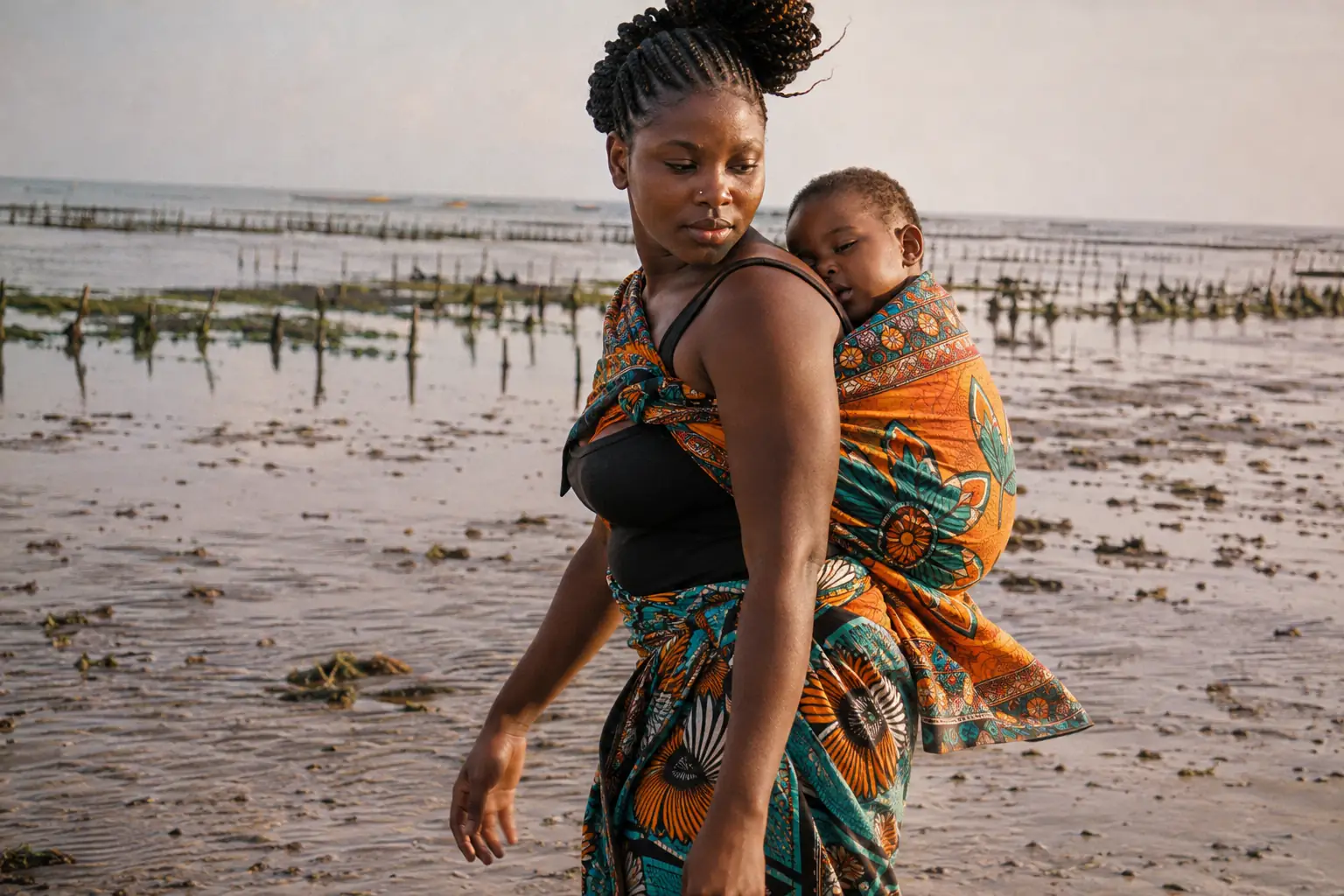
A kanga carries a baby, and a life. Image: The Uju Edit, created with AI.
The cloth carried politics
A kanga can wear its politics openly. One commemorative kanga from the Second World War reads Ahsante bwana Churchill: "Thanks, Boss Churchill."
It can also hide them. In the push for Tanganyika's independence, which came in 1961, women campaigned for Julius Nyerere in kangas printed with sayings. According to Msangi, the British didn't recognize the coded meanings, so pro-independence messages could travel on women's bodies without anyone being arrested. Hamid wrote that rather than wear British-made kangas, women in Tanganyika imported their own, with their own messages, from India and China.
After independence, kangas showed up at political rallies and in campaigns for health and education. Zanzibar marked forty years of its revolution with a kanga that reads, "Forty years of revolution is a sign of success." Tanzanians wore kangas supporting John Magufuli in the 2020 presidential election. Some younger women now prefer to wear their kangas with the message hidden. Even that says something.
Matching kangas, raised voices. Image: The Uju Edit, created with AI.
Made in Mumbai, Osaka and Dar es Salaam
For most of its life, the kanga was printed far from the coast that wore it. The Dutch company Vlisco, the same firm at the center of the wax print story, printed kangas for East Africa for nearly a century. British printers stopped making kangas in the late 1950s and the Dutch in the late 1960s. Many of the 20th century's kangas came from Japan.
Then Tanzania built its own. In 1967, with investment from China, the country founded the Urafiki Textile Mill in Dar es Salaam. Urafiki means "friendship." The mill is still running. Through the 1970s, protectionist policies left Japan as the only foreign supplier.
Today kangas are made in Kenya, Tanzania, Oman, India and Pakistan, and China has become the largest producer. When AramcoWorld visited in 2017, Zanzibar's oldest kanga dealership, Chavda Textiles in Stone Town, was sending up to 30 new designs a month to its factory in Mumbai. One of its designers, Sabrina Ally, then 24, had already created many popular kangas.
The kanga traveled in the other direction, too. When American shops sold cheap dashikis in the late 1960s, many were cut from kanga prints, as we wrote in our dashiki story.
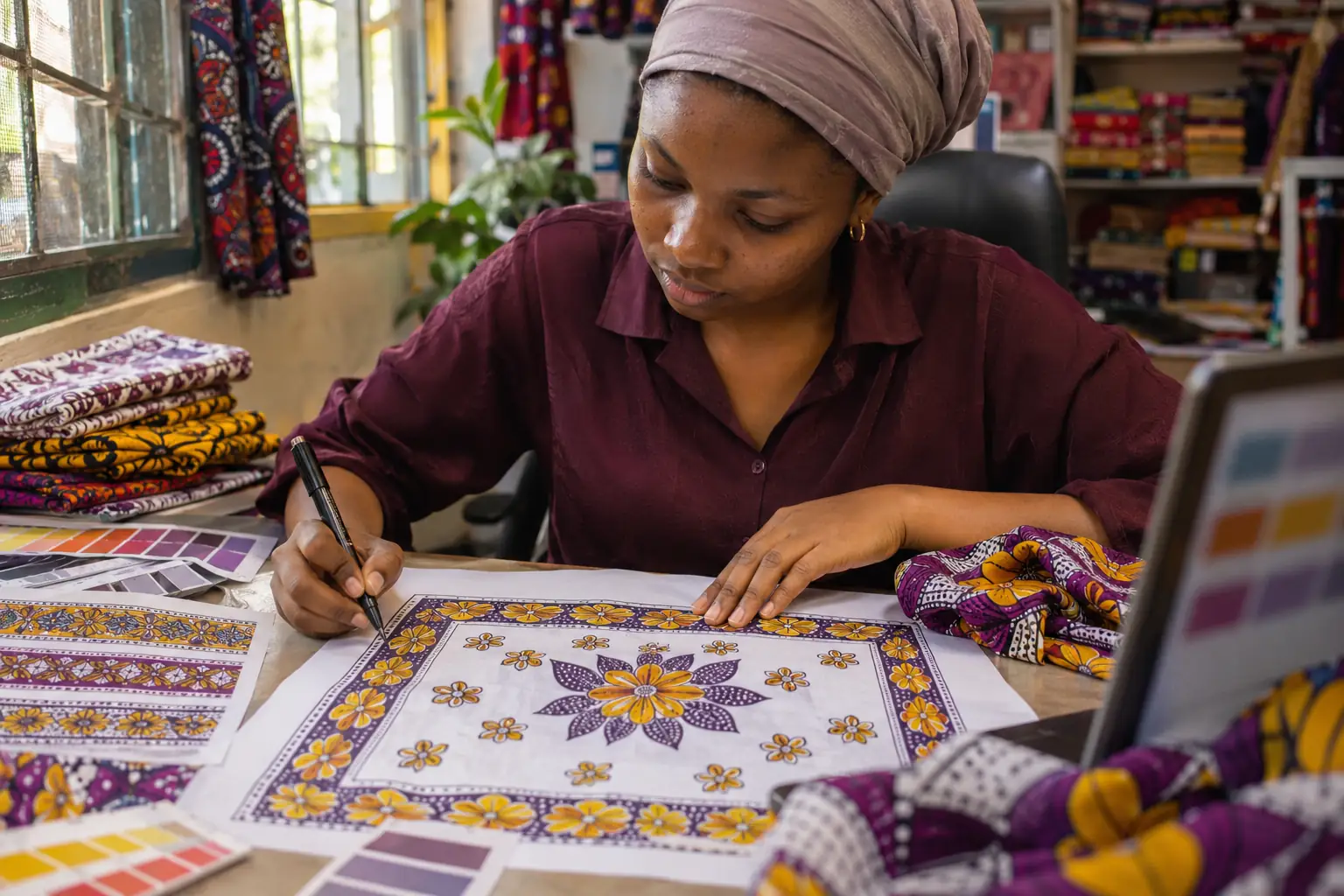
The pattern drawn, the order sent, the cloth printed elsewhere. Image: The Uju Edit, created with AI.
Still talking
Artists have picked the form up. Msangi designs his own kangas, with sayings like Ushirikiano wangu atakuja kwa bei, "My cooperation will come at a price," a reference to the African Carrier Corps conscripted to haul supplies for the British in the First World War. Another reads, "Do not interpret my silence as approval." His kanga show debuted in 2011, and several designs are now in the collection of the Erie Art Museum.
That last line could stand for the whole tradition. For more than a century, women on the Swahili coast have been told to watch what they say. They've answered with cotton.
Do not interpret my silence as approval.
One piece over the head, one at the waist. The message is hers to show. Image: The Uju Edit, created with AI.
So, what does a kanga say?
Whatever the woman wearing it decides.
It can say she's in love, or that she's heard the gossip and doesn't care. It can say thank you to Churchill or goodbye to colonial rule. It can say she was satisfied with her life. It was born from Portuguese handkerchiefs, Indian calico and American cotton, printed in Europe and Asia, named after an African bird. The words, though, have always been hers.
Sources and research
- Kanga's Woven Voices · Amanda Leigh Lichtenstein, AramcoWorld, November 2017
- Kanga · Encyclopedia of Clothing and Fashion (via Encyclopedia.com)
- Swahili Proverbs: Kangas · University of Illinois
- Kanga: A Cloth That Unites · National Museums of Kenya, Google Arts & Culture
- Khanga with "Wawili wakipendana adui hana nafasi" · National Museums of Kenya, Google Arts & Culture
- How to wear a kanga without causing offence (interview with Chris Spring, British Museum) · Wanderlust
- Kiswahili proverb kanga · Unwrapping African Commemorative Cloth, University of Alberta
- Collection of and commentary on 436 sayings on East African cloth · African Proverbs, Sayings and Stories
- Chapter on Indian Ocean trade and kanga (citing Amory's history) · Taylor & Francis
- Kanga cloths at Vlisco: an object-based study of Dutch printing for the colonial East African market, 1876-1971 · MacKenzie Moon Ryan
- A decade of design: the global invention of the kanga, 1876-1886 · MacKenzie Moon Ryan, Textile History, 2017
- Japanese kanga production and distribution in the twentieth century · Springer
- Kangas, by Caroline Stone · Textile Research Centre, Leiden
- The kisutu: the longest-living kanga · Marije Boerma, Textile Research Centre, Leiden
- Kanga · Mahfoudha Alley Hamid, African Journal of Political Science, 1996
- Origin of kangas in Tanzania · The Citizen
- The Secret, Subversive + Revolutionary Language of the East African Kanga · Margaret Andersen, AIGA Eye on Design, 2018
- If the cap fits: kanga names and women's voice in Swahili society · Saida Yahya-Othman, 1997
- Kanga: The Cloth That Speaks · Sharifa Zawawi (book, 2005)
- Social Fabric: African Textiles Today · British Museum, Google Arts & Culture
- Kanga (garment) · Wikipedia
- Dashiki · Encyclopedia of Clothing and Fashion (for kanga-print dashikis)
If your clothes could say one sentence for you today, what would it be?


In conversation
0 comments
Sign in by email to comment
First comments and comments with links await review. Community guidelines